The short version
A GPU is a space heater that does math. Roughly every watt that goes into an AI chip comes back out as heat, and that heat has to be physically carried somewhere or the chip throttles itself, degrades, and eventually dies. For thirty years the answer was to blow air across metal fins. That answer is finished. Modern AI racks generate more heat in one cabinet than a suburban house uses in total, and the fans simply cannot move it.
So the industry is re-plumbing itself, at speed, with liquid. That makes cooling one of the rare spending categories nobody gets to skip: you can delay a software project, but you cannot install a $3 million GPU rack and decide not to cool it. The money is showing up in the numbers. Vertiv is sitting on a $15 billion backlog, Modine has gone from a legacy radiator company to one where data centers are 35% of revenue, and nVent expects to book more than $2 billion of data-center sales this year.
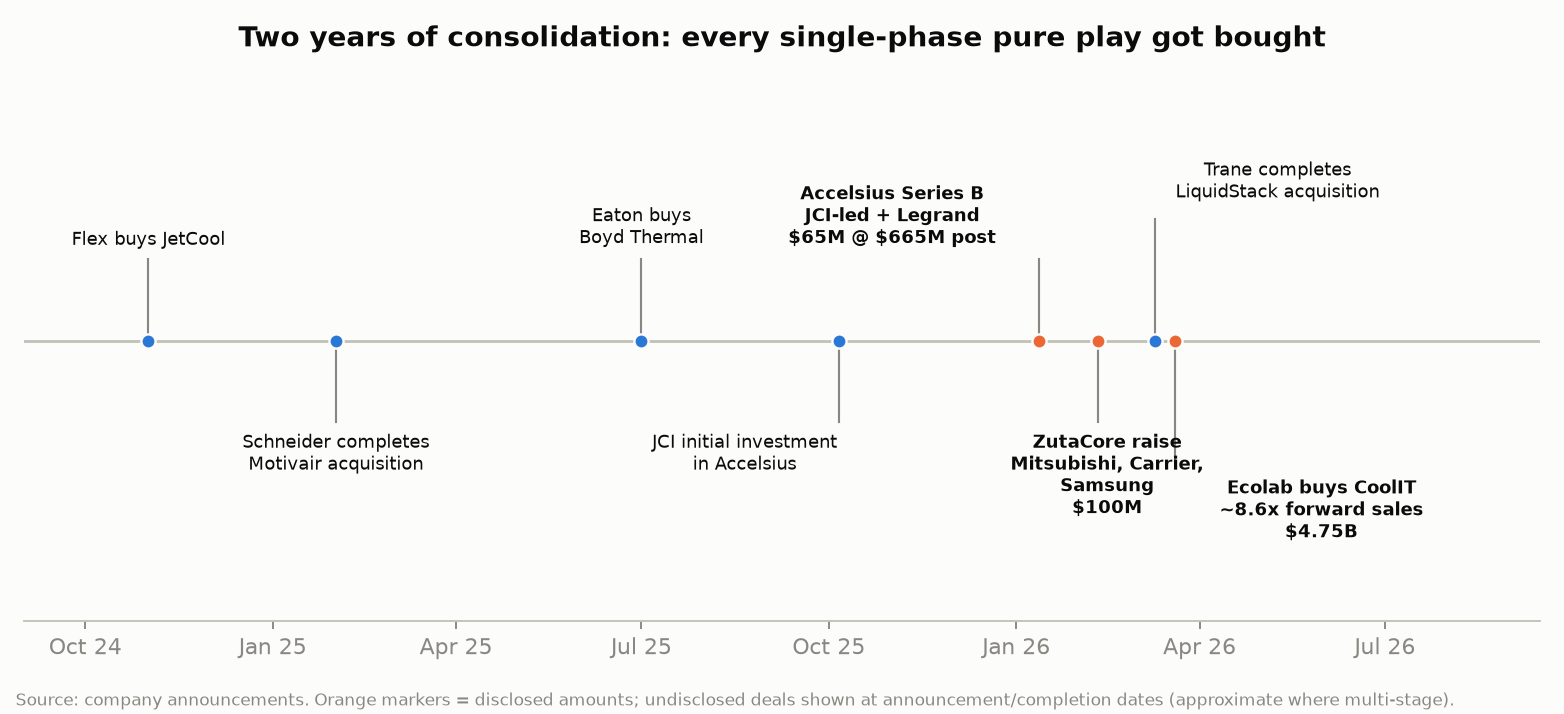
The people who know this industry best have already been buying. In the last two years every independent single-phase cooling specialist of any size has been bought, the biggest being Ecolab paying $4.75 billion for CoolIT in March, about 8.6 times forward sales for a company doing $550 million. Meanwhile Johnson Controls, Legrand, Carrier, Mitsubishi Electric, and Samsung have all quietly funded the two-phase startups that might be the next generation.
This report is a map of who actually makes what, and which of them you can own. “Cooling stocks” is not one trade. It is at least four, sitting at different points in the loop, with very different purity and risk.
Why heat became the whole story
There are three ways to get heat out of a data center, and two of them have closed.
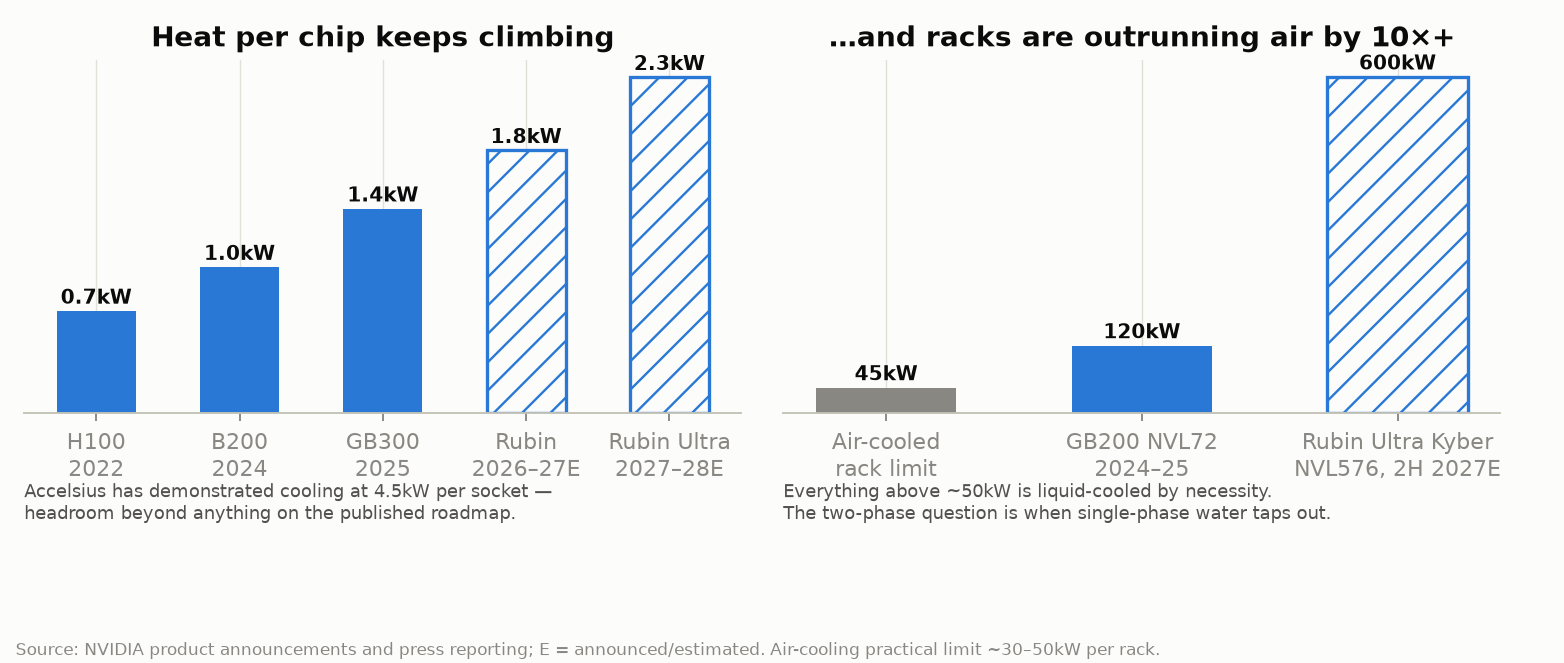
Air ran into physics. Fans and heat sinks top out somewhere around 30 to 50 kilowatts per rack, and that was fine for a decade of ordinary servers. An NVIDIA GB200 NVL72, which wires 72 Blackwell chips into one cabinet so they behave like a single giant GPU, pulls about 120kW. You cannot fan your way out of that. Air didn’t get worse. The chips got much hotter, and the gap can’t be closed.
Evaporative water towers ran into politics. The traditional cheap fix is to spray water and let evaporation carry the heat off, which works beautifully and consumes millions of liters. Communities from Texas to Arizona started saying no, and projects began stalling in permitting. What used to be the easy answer now gets blocked at the permitting stage.
That leaves liquid, in a sealed loop, touching the chip. It is the only remaining option, which is the main argument for it.
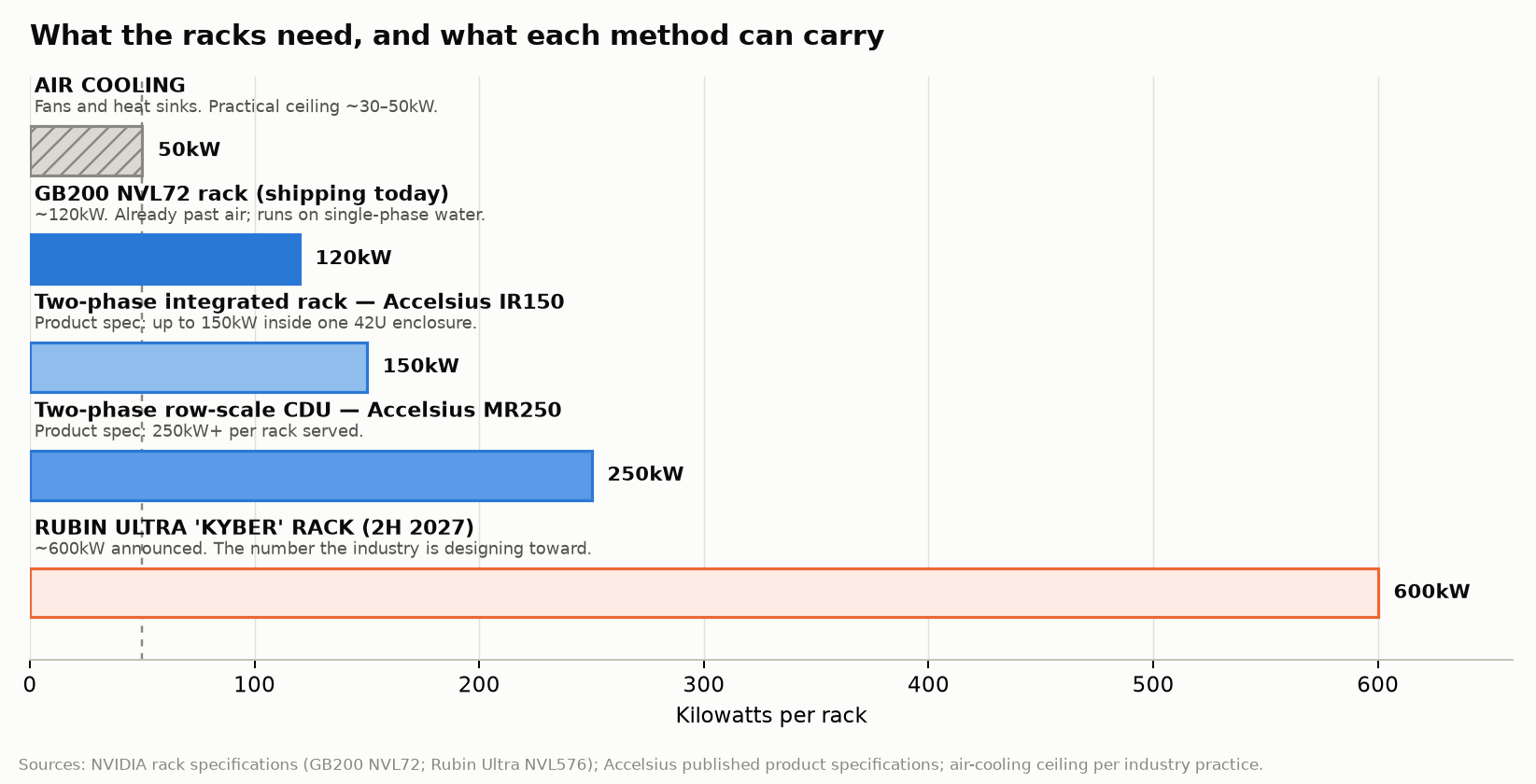
And the demand side keeps moving. NVIDIA’s announced Rubin Ultra “Kyber” rack, due in the second half of 2027, is specified around 600kW, five times a GB200 cabinet, twelve times what air can handle. Individual chips are heading past 2,000 watts each. Every generation of this roadmap makes the cooling problem harder in a way that is public, scheduled, and impossible for operators to ignore.
The three ways to move heat, in plain terms
Single-phase direct-to-chip is what almost everything ships with today. A machined copper block called a cold plate bolts directly onto the chip, and water mixed with glycol runs through tiny channels inside it, warms up a few degrees, and carries the heat away. It never boils; one phase, start to finish. Think of a car radiator, shrunk and mounted on the processor. It is proven, well understood, and it is what NVIDIA’s reference designs assume. When people say “liquid cooling is going mainstream in 2026,” this is what they mean.
Two-phase direct-to-chip looks the same from the outside and works on a different principle. The fluid is engineered to boil right at the chip surface. Boiling absorbs an enormous amount of heat compared with simply warming a liquid, which is why sweating cools you far better than merely being wet. Three practical consequences follow. The chip runs cooler at the same load, which buys headroom. The fluid is dielectric, so a leak doesn’t short out a rack full of very expensive silicon the way water does. And because two-phase strips heat so efficiently, the building’s water loop can run warm enough that you can often cool it with outside air instead of running chillers, which is real money on the electric bill.
The catch is that vapor is harder to engineer around than liquid, and the fluids are specialized and expensive. Two-phase is the challenger today. If the roadmap above keeps going, it’s a strong candidate to become the default.
Immersion takes the whole server and drops it in a bath of dielectric fluid, no cold plates at all. It’s elegant and it works, and it’s being deployed in real sites. But it requires you to redesign the data center around it, and the industry has not committed to that the way it has to direct-to-chip. Real and deployed, but still unsettled.
Following the heat through the loop
This explains why so many different companies all describe themselves as liquid-cooling plays. They’re standing at different points along the same pipe.
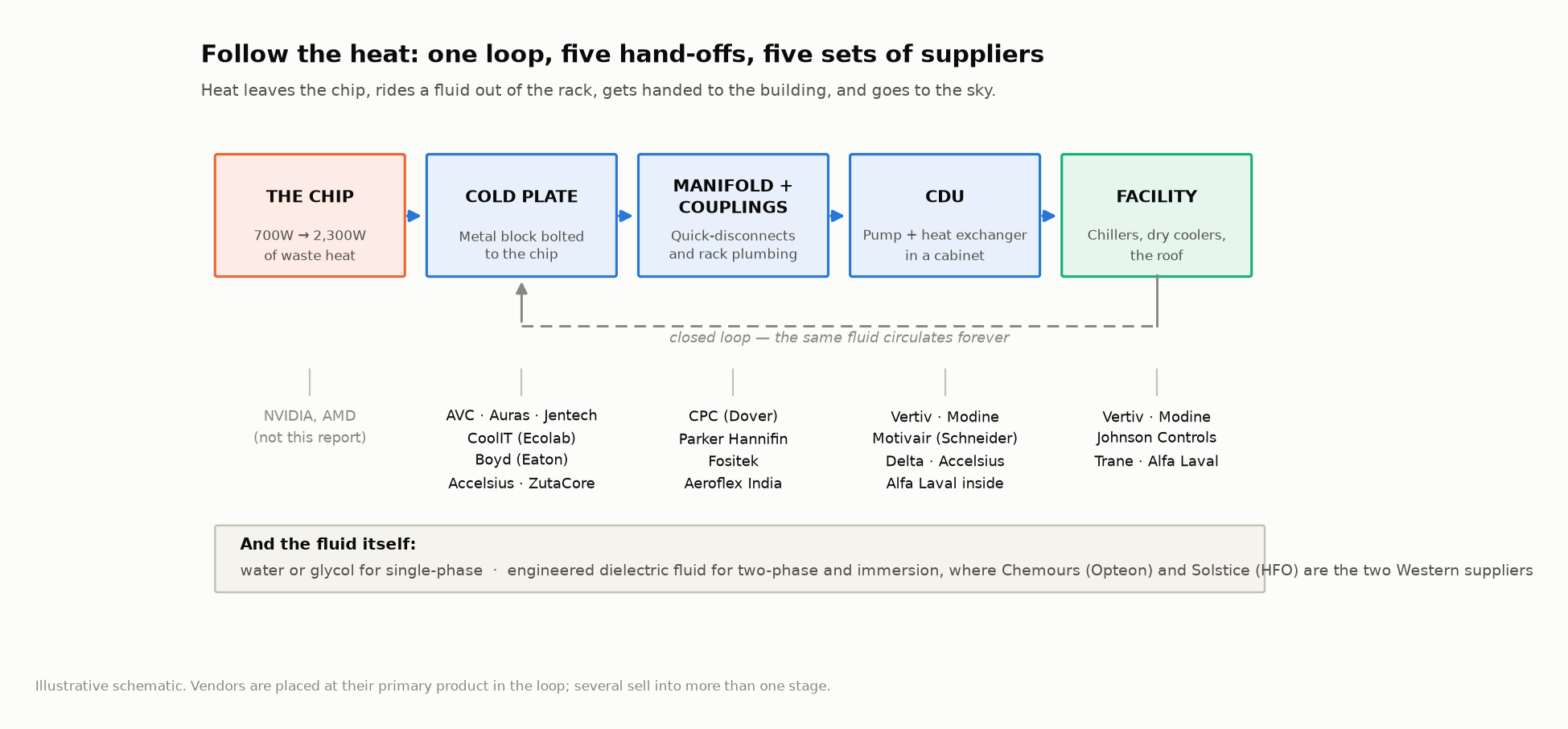
Heat leaves the chip into the cold plate. It travels through manifolds and quick-disconnect couplings, the plumbing that lets a technician pull a server out of a rack without spraying coolant over a million dollars of hardware, which is exactly as failure-sensitive as it sounds. It arrives at the CDU, the coolant distribution unit, which is essentially a pump, a heat exchanger, filtration, and controls in a cabinet. The CDU’s real job is separation: it keeps the clean, tightly-controlled fluid that touches your GPUs isolated from the messier facility water, and hands heat across between them. Inside that CDU is usually a brazed plate heat exchanger, a stack of corrugated stainless plates fused together, hot fluid in every other channel, cold fluid in between, enormous surface area packed into something the size of a shoebox. Alfa Laval is the name that shows up there over and over. Finally the facility takes the heat and rejects it with chillers, dry coolers, or the roof.
Every one of those hand-offs is a product with a supplier, a margin, and a competitive position. And one input cuts across all of it: the fluid.
What the buyers have already paid
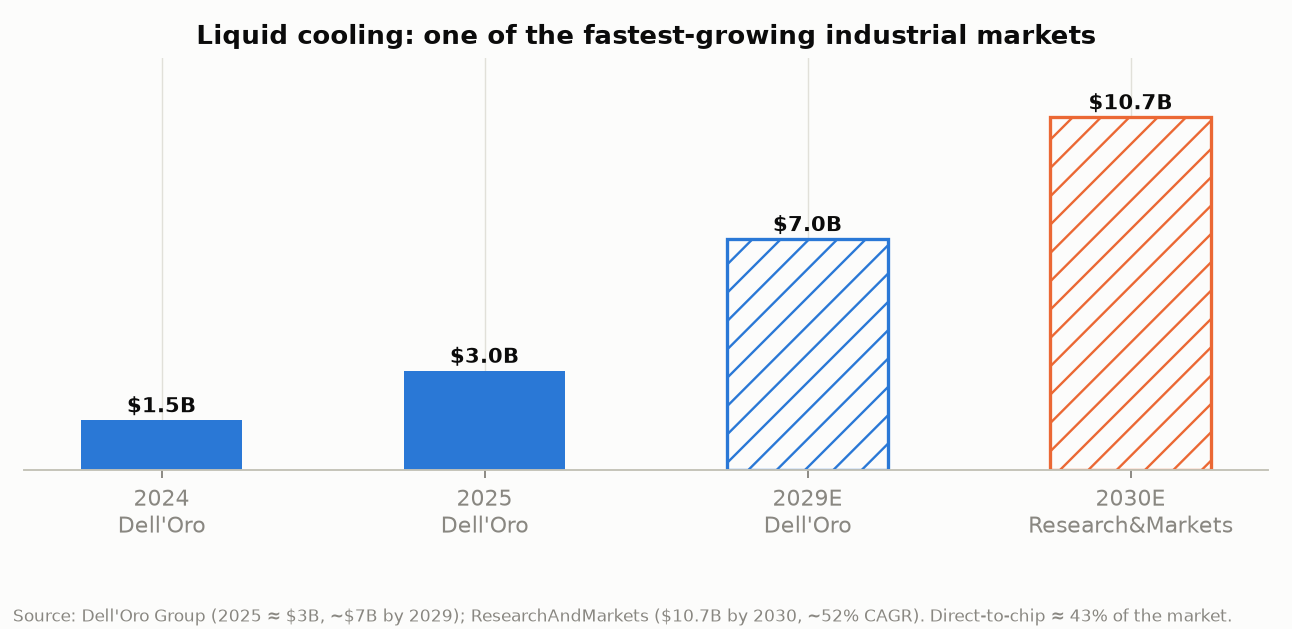
Dell’Oro puts data-center liquid cooling at roughly $3 billion in 2025, which was about double 2024, heading to ~$7 billion by 2029. Other houses get to $10 billion or more by 2030 on ~50% compound growth. Direct-to-chip is the biggest slice at around 43%. Even the conservative version of this is one of the fastest-growing industrial markets in the world. The heat-exchanger niche alone is forecast to go from about $7.7 billion in 2026 to $14.4 billion by 2032.
More telling than any forecast is what the strategic buyers actually paid. Flex bought JetCool. Schneider Electric took Motivair. Eaton bought Boyd’s thermal business, roughly $1.7 billion of cooling revenue. Trane closed on LiquidStack. And in March, Ecolab, a water and hygiene company rather than an obvious data-center player, paid $4.75 billion in cash for CoolIT, about 8.6 times forward sales and 29 times forward EBITDA on roughly $550 million of revenue at 30% margins. That deal has already closed.
Look at the list again: there are no independent single-phase specialists of scale left. They were all acquired, mostly by industrial giants who understand this market better than any of us do, at prices that assume years of growth.
The same thing is happening one generation out, in two-phase, except with venture checks instead of acquisitions. Johnson Controls made an initial investment in Accelsius in October 2025, then led its $65 million Series B at a $665 million valuation in January with Legrand alongside. Weeks later ZutaCore, the other credible two-phase name, raised $100 million from Mitsubishi Electric, Carrier, and Samsung. When Carrier and Johnson Controls end up funding competing startups in the same niche, they are both telling you they expect that niche to matter.
Layer 1: the companies selling complete systems
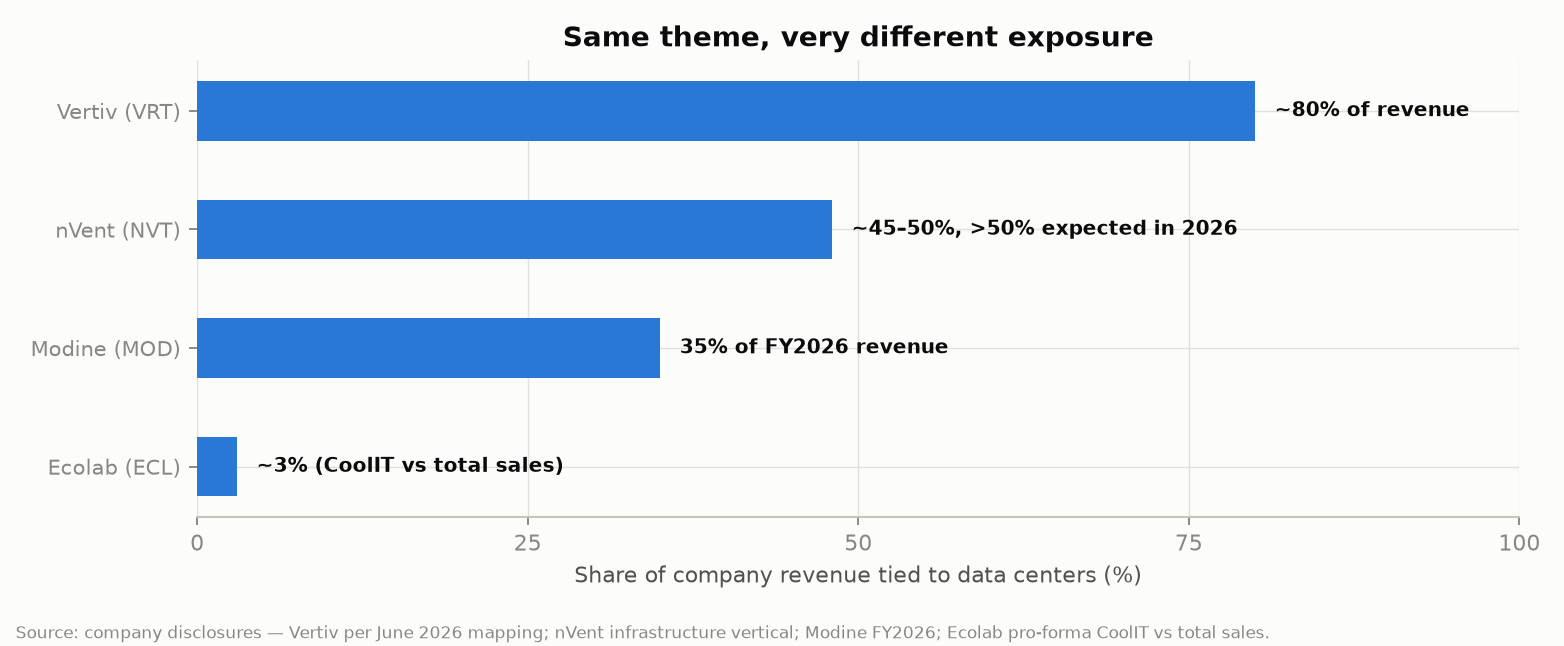
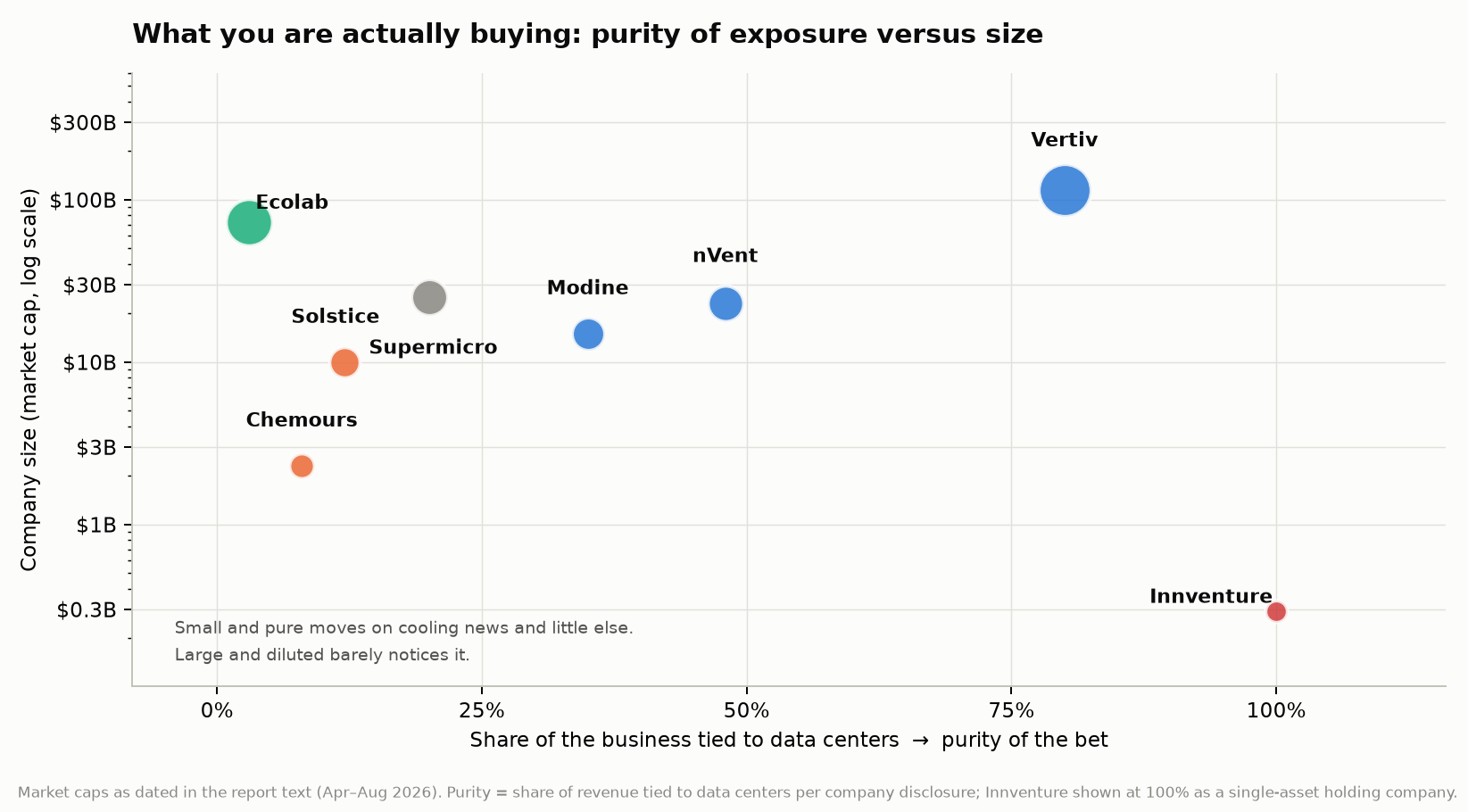
Vertiv (VRT) is the closest thing this sector has to an index. It sells the entire thermal chain (CDUs, cold-plate loops, heat rejection) plus power gear and the service organization that keeps it running, and roughly 80% of its revenue is tied to data centers. The second quarter was strong almost everywhere: revenue $3.27 billion, up 24%; adjusted EPS of $1.52 against 95 cents a year ago, comfortably ahead of the $1.42 consensus; operating margin up 410 basis points to 22.6%; $1.1 billion of operating cash flow; $5.6 billion of liquidity and a net cash position. Backlog stands at $15 billion, and management raised full-year guidance to roughly 31% organic growth with adjusted EPS up 50–52%. Revenue did come in light against the $3.38 billion analysts wanted, which is worth noting mostly because it shows how high the bar has become. At roughly $115 billion, you are paying a premium for the category leader executing very well. You are underwriting the AI capex cycle itself more than anything company-specific.
Modine (MOD) is the same trade with more torque. It’s an old-line thermal company, radiators and HVAC, that has been reborn around its Airedale line of chillers, CDUs, and direct-to-chip products. Fiscal 2026, which ended in March, brought $3.18 billion of sales, up 23% from $2.58 billion, and data centers grew to 35% of revenue, clearing $400 million in the final quarter alone. It holds a $4 billion long-term chiller agreement with a single hyperscaler and is targeting more than $2 billion of data-center revenue by fiscal 2028, roughly a double. At around $15 billion it’s a fraction of Vertiv’s size and considerably less diversified, which is the entire point: it moves harder on data-center news in both directions.
Ecolab (ECL) is the conservative way to own this theme. It’s a ~$73 billion water and hygiene business that just installed a genuine direct-to-chip franchise inside itself by buying CoolIT, doubling its stated high-tech opportunity from $5 billion to $10 billion and targeting $4 billion of high-tech sales by 2030. Cooling here sits on top of an already solid business rather than carrying it. That means the downside is well protected and the upside is diluted; a spectacular year in liquid cooling still only nudges the consolidated numbers.
Supermicro (SMCI) ships more direct-to-chip liquid-cooled racks than almost anyone, and its speed in adopting new cooling designs is genuinely part of how it wins GB200 and GB300 business. But the stock trades on AI server demand generally, at assembly margins, against Dell and the Taiwan ODMs. Around $25 billion, it gives you exposure to the buildout without much pricing power over any piece of it. Own it for the server cycle if you want it; it isn’t really a cooling thesis.
Layer 2: the two-phase option
The two companies most likely to define two-phase cooling, Accelsius and ZutaCore, are both private, and both just got funded by strategics who plainly intend to own this capability. You cannot buy either one.
The one listed route is Innventure (INV), a holding company that owns 43.2% of Accelsius and trades at roughly the paper value of that stake. It comes with real technology, a flagship customer deal that a short seller claims is fictitious, going-concern language in its filings, and a share count that grows every quarter. It is a genuine option on the two-phase transition and should be sized like an option premium.
What makes this layer interesting despite that mess is the shape of the disagreement. The skeptical case, that single-phase water is good enough through the Rubin generation, is currently correct, and might stay correct for years. The believer’s case is that 600kW racks and 2,000-watt chips eventually break it, and that when they do, the qualification cycles are long enough that whoever has already been running in production wins. Johnson Controls, Legrand, Carrier, Mitsubishi, Samsung, and Trane are collectively paying to be on the right side of that if it happens. Until it does, the pure-play burns cash.
Layer 3: the fluid
If two-phase or immersion scale, somebody has to make the fluid. Unlike the hardware layers, this one sells a consumable. It gets topped up, replaced, and sold again as racks multiply. The hardware vendor wins a deal once; the fluid supplier gets paid for as long as the rack runs.
There are exactly two credible Western suppliers.
Solstice Advanced Materials (SOLS) is the higher-quality way in. Spun out of Honeywell in late 2025, it’s around $10.4 billion in market value and its Solstice HFO chemistry is half the duopoly. The business is performing: second quarter revenue of $1.15 billion against $1.08 billion expected, net sales up 11%, full-year guidance raised to $4.13–4.19 billion with adjusted EBITDA of $1.04–1.06 billion, and a backlog above $2 billion. It’s also putting real capital behind the theme: a $200 million expansion of its Spokane Valley electronic-materials site and continued Baton Rouge HFO refrigerant production. Data-center fluids sit inside a broader specialty-materials franchise that’s growing on its own, which is a comfortable place to take this exposure.
Chemours (CC) is the deep-value version, with genuine baggage attached. Its Opteon line is the other half of the duopoly, and the commercial progress this year is concrete rather than promotional: Samsung qualified the Opteon two-phase immersion fluid, a joint development agreement with server maker 2CRSi followed in February, and Chemours has contracted Navin Fluorine to manufacture the fluid at scale starting this year. The company claims Opteon two-phase can cut cooling energy up to 90% versus air with a power usage effectiveness approaching 1. But it carries heavy PFAS liability with billions already agreed in settlements, high leverage, and the hangover of a 2024 accounting probe. At roughly $2–2.5 billion it’s cheap for reasons that are easy to name. You’re buying a litigation-wrapped version of the exposure Solstice gives you cleanly.
One risk applies to the whole layer: these are fluorinated chemistries, and PFAS regulation is the main risk hanging over the category. 3M’s exit from PFAS production is exactly why the supply base is this concentrated, which helps the survivors commercially and concentrates the regulatory exposure at the same time.
Layer 4: hardware you can actually own
nVent (NVT) may be the best risk-adjusted name on this whole map. It’s an electrical-infrastructure company whose center of gravity has visibly moved: the infrastructure vertical reached about 45% of sales and management expects it to pass 50% this year, with more than $2 billion of data-center sales expected in 2026 on consensus revenue of $4.98 billion, up 27.9%. It sells white-space liquid cooling and has an alliance with Iceotope for precision immersion. At roughly $23 billion as of late April, you get most of Vertiv’s demand story with less of the crowding.
Alfa Laval (ALFVY) is the less visible one. The Swedish heat-transfer giant makes the brazed plate heat exchangers that sit inside essentially every CDU and immersion loop, regardless of whose logo is on the cabinet. It is treating data-center demand as structural rather than cyclical: in February it announced a multi-year investment to double plate heat exchanger capacity at its Richmond, Virginia plant by mid-2028, specifically citing data-center supply constraints. Cooling is one engine inside a large diversified industrial spanning Energy, Food & Water, and Marine, so this compounds rather than spikes. It’s the most technology-agnostic exposure in the report: single-phase, two-phase and immersion all need the heat exchanger. Trades in the US as an unsponsored ADR under ALFVY.
Delta Electronics (DLELY) is Taiwan’s power-electronics giant, shipping liquid-cooled racks and CDUs in volume under its SideCar line alongside the power train that feeds them. Converged power and thermal is a real advantage as racks get denser and the two problems stop being separable. Cooling is a slice of a very large business, so think of it as diversified AI-infrastructure exposure with cooling attached. Also available as an ADR.
Two more worth a sentence each. Dover owns CPC, one of the leading makers of the quick-disconnect couplings the whole industry depends on, and Parker Hannifin has the NPN-approved universal quick disconnect line. Both are excellent companies where couplings are a rounding error on the P&L, so the exposure is real but thin. Trane owns LiquidStack inside a $100 billion-plus HVAC business, same story.
The ones you probably can’t buy
These have no US listing and no ADR, so they trade only at home. They’re here because they’re load-bearing parts of the chain, and because their numbers are useful even if you never own a share.
- Asia Vital Components (3017.TW): the cold-plate giant, with an estimated 40–50% share of NVIDIA GB200 and GB300 cold plates and a named Vera Rubin supplier slot. The purest leverage to liquid-cooled unit volume that exists anywhere.
- Auras (3324.TW): clear number two. Liquid cooling is about 35% of its mix and it holds roughly 25% of GB300 cold-plate share.
- Jentech (3653.TW): the smaller precision and microchannel specialist on the NVIDIA roadmap.
- Fositek (6805.TW): a hinge maker that pivoted hard into quick-connect components, now about half its revenue, and is building next-generation connectors for the Rubin platform.
- Aeroflex Industries (NSE/BSE, India): stainless braided hoses, assemblies, and cooling skids: the secondary fluid network that carries coolant through the white space. It sells into single-phase, two-phase, and immersion alike, is scaling skid capacity from 2,000 to 13,000 units a year, and is up around 140% in a year on a ~$650 million market cap. (No relationship whatsoever to Innventure’s AeroFlexx packaging company, despite the nearly identical name.)
- DUG Technology (ASX): an HPC and seismic software company that runs its own immersion system, DUG Cool, and builds immersion-cooled campuses. About A$100 million; a curiosity for immersion purists.
Taiwan-listed companies report revenue monthly, which makes AVC and Auras the fastest public read on liquid-cooling unit volume available anywhere. You can use them as a dashboard for the whole theme without owning them.
What could go wrong
Everything in this report shares one master variable: hyperscaler capex. A digestion year hits Vertiv’s backlog conversion, Modine’s fiscal 2028 target, nVent’s growth rate, and the two-phase timeline all at once. You cannot diversify that away inside the sector; owning six cooling names is mostly owning the same bet six times.
Beyond that:
- Single-phase might just keep working. Better microchannels, higher flow rates and warm-water designs all keep the incumbent technology stretching. Every generation it survives pushes two-phase revenue further out. That’s bad for Layer 2, roughly neutral for everyone else.
- PFAS regulation could reshape the fluid layer’s economics, and it’s the specific reason Chemours trades where it does.
- NVIDIA decides the architecture. Reference designs and OCP standards determine what ships in volume. A design pivot re-ranks winners quickly, in either direction.
- Valuation. None of this is a secret. Vertiv on a premium multiple and Modine after a large run already price in years of execution. In Layers 1 and 4 your margin of safety is that these companies keep delivering, not that nobody has noticed them.
How I’d actually hold this
Sorted by the job each name does rather than by conviction:
- The core position: Vertiv, if you want the sector itself, or nVent for a slightly quieter version of the same demand with a lower profile.
- The torque: Modine, when you want something that moves hard on data-center news and can stomach it moving hard the other way.
- The compounder underneath: Alfa Laval via ALFVY. It doesn’t care which cooling architecture wins, and it’s spending capital as though the demand is permanent.
- The cautious version: Ecolab, for exposure inside a much larger, stable business.
- The interesting special situation: Solstice, on the theory that the consumable layer is underappreciated. Chemours only if you’re genuinely comfortable owning litigation risk for the discount.
- The lottery ticket: Innventure, sized accordingly, and only if you have read the going-concern language and the short-seller dispute in its filings yourself.
- Free instrumentation: AVC and Auras monthly revenue for unit volume, Chemours and Solstice fluid commentary for how fast two-phase is actually deploying, and NVIDIA’s thermal reference designs for where the architecture goes next. None of these require you to own anything.
Sources
- Market size: Dell’Oro liquid-cooling forecast · Uptime Institute on two-phase · heat-exchanger market projection
- Deals and funding: Ecolab–CoolIT close · Accelsius Series B · ZutaCore $100M · Trane–LiquidStack and the consolidation wave
- Companies: Vertiv Q2 2026 · Modine FY2026 · nVent raised outlook · Solstice · Chemours–2CRSi · Chemours–Navin Fluorine · Samsung qualifies Opteon · Alfa Laval Richmond expansion · ALFVY · DLELY
- Framing: Emil Hartela’s June 7, 2026 supply-chain mapping (@emilhartela); NVIDIA product announcements for rack and chip power